Signal and Silence: Inside the Military's Classified Sensor Networks and the Phenomena They Won't Name
The United States government does not lack the ability to detect anomalous phenomena in its airspace. It lacks, by institutional design, the willingness to characterize what it detects.
This distinction matters enormously. Over the past several years, a combination of congressional pressure, limited declassification, and determined Freedom of Information Act litigation has pulled back a corner of the curtain surrounding the military's atmospheric and near-space monitoring capabilities. What has emerged is not a picture of ignorance — of a government genuinely puzzled by unexplained signals — but rather a portrait of deliberate compartmentalization, in which detection is sophisticated, documentation is extensive, and disclosure is systematically withheld.
A Sensor Architecture Built for Omniscience
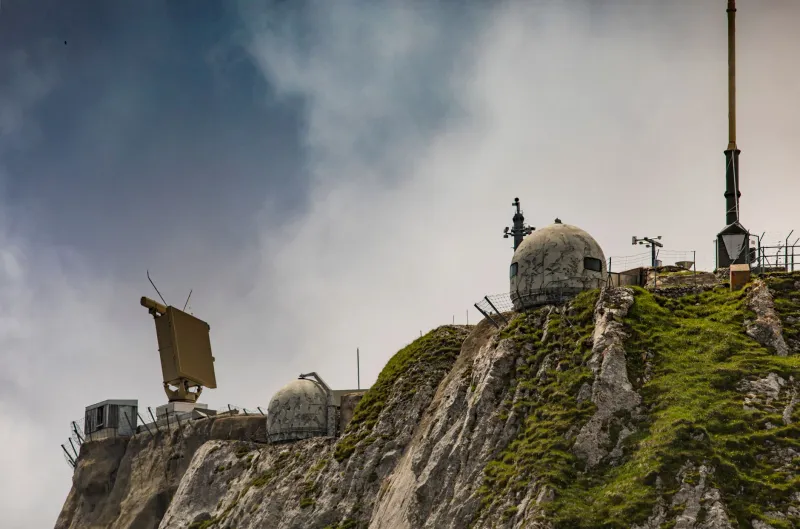
To understand what the military can detect, it is necessary to first appreciate the scale and technical depth of the infrastructure it operates. The US Department of Defense maintains a layered detection ecosystem that spans land-based radar installations, sea-borne sensor platforms, satellite-mounted optical and signals intelligence systems, and airborne collection assets capable of operating across multiple spectral bands simultaneously.
The Space Surveillance Network, operated jointly by the US Space Force and US Strategic Command, tracks tens of thousands of objects in Earth orbit with sufficient fidelity to catalogue debris fragments as small as ten centimeters. Ground-based radar systems such as the AN/FPS-85 phased-array facility at Eglin Air Force Base in Florida can simultaneously track hundreds of objects across an enormous volume of space. The Cobra Dane radar installation on Shemya Island, Alaska — originally designed to monitor Soviet missile tests — remains operational and contributes data to overlapping collection programs whose full scope is not publicly disclosed.
At lower altitudes, the North American Aerospace Defense Command, known as NORAD, maintains continuous radar coverage of US and Canadian airspace through a network of long-range and gap-filling installations. The system was designed to detect inbound ballistic threats, but its sensitivity is not limited to objects that match the signature profile of known adversary missiles.
The question that FOIA requests and congressional hearings have begun to surface — imperfectly, incompletely — is what happens when these systems detect something that does not match any catalogued object or recognized flight profile.
The Gap Between Detection and Disclosure
In 2021, the Office of the Director of National Intelligence released a preliminary assessment on what it termed Unidentified Aerial Phenomena, or UAP — a document that acknowledged 144 reports from military aviators but characterized the majority as unexplained. The report was notable less for what it revealed than for what its framing implied: that sensor data of sufficient quality to warrant formal intelligence assessment existed, but that the findings derived from that data were not being shared with the public or, in many cases, with the members of Congress who had requested the review.
Subsequent disclosures have reinforced this picture. Testimony delivered to the Senate Armed Services Committee in 2023 by David Grusch, a former National Geospatial-Intelligence Agency officer, described a multi-decade program of compartmentalized collection and analysis that operated with minimal congressional oversight. Grusch's claims — which he made under oath and which the Intelligence Community Inspector General assessed as credible and urgent — alleged that certain recovered materials and associated data were being withheld from authorized oversight bodies.
Whether or not one accepts the most dramatic elements of that testimony, the underlying bureaucratic structure it describes is consistent with documented classification practices. Programs can be compartmented at levels that exclude even members of the relevant oversight committees. Funding can be obscured within larger budget line items. And the personnel with direct knowledge of a program's findings can be legally prohibited from discussing those findings with anyone outside the compartment — including, in some cases, the Inspector General of their own agency.
What Declassified Specifications Actually Reveal
Technical analysis of the detection specifications that have been declassified or disclosed through litigation offers a partial window into the capability gap — the distance between what these systems can detect and what the government acknowledges detecting.
The Advanced Baseline Imager aboard the GOES-16 and GOES-17 weather satellites, operated by the National Oceanic and Atmospheric Administration, captures full-disk imagery of the Western Hemisphere at high temporal resolution across multiple spectral bands. While NOAA's mission is meteorological, the sensor architecture is capable of detecting and tracking fast-moving luminous phenomena in the upper atmosphere. Researchers who have examined GOES data for evidence of transient luminous events — a category of atmospheric phenomenon that includes sprites, elves, and blue jets — have noted that the instrument's sensitivity extends well beyond the objects it was nominally designed to observe.
Similarly, the Space-Based Infrared System, or SBIRS, operated by the US Space Force, was designed to detect the heat signatures of ballistic missile launches. Former program officials have acknowledged in open-source interviews that the system's sensitivity is sufficient to detect a wide range of energetic atmospheric events. The specific catalog of what SBIRS has detected beyond its primary mission — and how those detections are classified and stored — is not publicly available.
Requests submitted by this publication under the Freedom of Information Act for operational logs and detection summaries from both NOAA and the Space Force were either denied on national security grounds or acknowledged with multi-year processing timelines that effectively defer disclosure indefinitely.
The Compartmentalization Rationale and Its Limits
Government officials and defense analysts who speak on the record about UAP and related sensor programs typically offer one of two explanations for the information gap. The first is that disclosure of detection capabilities would reveal collection methods to adversaries, allowing them to calibrate their own activities to avoid observation. This is a legitimate concern with a long and well-documented history in signals intelligence.
The second rationale — that the phenomena being detected are simply not well-understood enough to characterize publicly — is more difficult to evaluate, precisely because the data that would allow independent assessment remains classified. It functions, in effect, as a self-sealing argument: the government cannot share what it knows because it doesn't fully understand it, and independent researchers cannot help advance that understanding because the underlying data is withheld.
Dr. Garry Nolan, a Stanford immunologist who has consulted with defense and intelligence agencies on UAP-related materials analysis, articulated the problem in congressional testimony: the scientific community cannot engage meaningfully with phenomena that are documented in classified databases but excluded from the open literature. The result is a systematic exclusion of independent expertise from questions that have direct implications for national security, aerospace safety, and potentially for fundamental physics.
Toward a Framework for Legitimate Inquiry
The argument for greater transparency in this domain is not predicated on any particular conclusion about what these detection systems are observing. It rests instead on a more basic principle: that a democratic government operating sophisticated monitoring infrastructure with public funds has an obligation to account for what that infrastructure finds, subject to legitimate and narrowly defined security constraints.
The current arrangement — in which detection is comprehensive, analysis is ongoing, and disclosure is structurally prevented — does not serve that principle. It concentrates knowledge in compartments insulated from oversight, forecloses the scientific engagement that might actually advance understanding, and leaves the public dependent on occasional, partial, and heavily managed disclosures that raise more questions than they answer.
The sensors are running. The data is accumulating. What is being seen, and what those observations mean, remains — by deliberate institutional design — a matter of official silence.